
Blindness in India: Why Cataract Matters
Cataract remains the leading cause of blindness in India, particularly among people aged 50 years and above. According to the National Blindness and Visual Impairment Survey (2015–19):
- Cataract accounts for about 2% of all blindness cases in the country.
- India has seen a notable reduction in overall blindness prevalence over recent decades, but cataract continues to be the dominant cause of vision loss.
- More than 85% of vision loss cases in India are preventable or treatable, with cataract surgery being the most effective intervention.
These statistics highlight the critical importance of early detection, treatment, and access to quality surgical care.
Cataract Treatment at SRRLEH
Intraocular Lens (IOL) Options at SRRLEH
Empowering You in Your Treatment Journey
Cataract Treatment at SRRLEH
At Smt. Rajeswari Ramakrishnan Lions Eye Hospital (SRRLEH), we offer advanced surgical care to remove cataracts safely and effectively. Our experienced surgical team uses modern techniques tailored to individual patient needs.
Surgical Techniques Available
Small Incision Cataract Surgery (SICS)
- A manual technique using a slightly larger incision
- Particularly useful for very advanced or hard cataracts
- Reliable option in complex cases where phacoemulsification may be challenging
Phacoemulsification (Phaco)
- A minimally invasive method
- A fine ultrasonic probe breaks the cataract into tiny pieces
- Fragments are gently suctioned out through a small incision (typically 2.2–2.8 mm)
- Usually no stitches required
- Offers faster healing and quicker visual recovery
Your eye surgeon will decide the ideal technique based on the type and density of the cataract, your visual needs, and overall health.
Intraocular Lens (IOL) Options at SRRLEH
After the cataractous lens is removed, the natural lens is replaced with an artificial Intraocular Lens (IOL). At SRRLEH, we offer a variety of IOL options to meet different visual goals:
Monofocal Lens
- Provides clear distance vision
- May still require glasses for reading or close work
Toric Monofocal Lens
- Corrects astigmatism in addition to providing distance vision
- May still require glasses for near tasks
Aspheric Lens
- Offers enhanced contrast sensitivity
- Better quality vision in low light and night conditions
Multifocal Lens
- Designed to improve vision at near, intermediate, and far distances
- Reduces dependence on glasses (though occasional use may still be necessary)
Multifocal Toric Lens
- Combines astigmatism correction with multifocal benefits
- Provides improved vision across all distances
Can reduce reliance on spectacles for most tasks
Empowering You in Your Treatment Journey
Understanding your diagnosis and treatment options helps you make informed decisions with your eye care team. Cataract surgery is one of the most successful and commonly performed eye surgeries worldwide, and at SRRLEH we ensure a safe, personalized, and comfortable experience for every patient.
What is Cataract?
A cataract occurs when the eye’s natural lens becomes cloudy, leading to blurred or dim vision. Over time, the clouding increases, interfering with the eye’s ability to focus light onto the retina. Cataracts can affect one or both eyes and generally develop slowly.

Causes of Cataract
Cataracts can develop due to several factors:
- Age-related changes (most common)
- UV light exposure
- Diabetes and metabolic conditions
- Eye injury or inflammation
- Long-term use of certain medications (e.g., steroids)
Genetic or congenital predisposition

Common Symptoms
Patients with cataract typically experience:
- Blurred or cloudy vision
- Difficulty seeing at night or in low light
- Glare or halos around lights
- Fading or yellowing of colors
- Frequent changes in eyeglass prescription
- Poor vision while reading or driving
If you notice these signs, consult an eye doctor promptly for evaluation.

Cataract Diagnosis
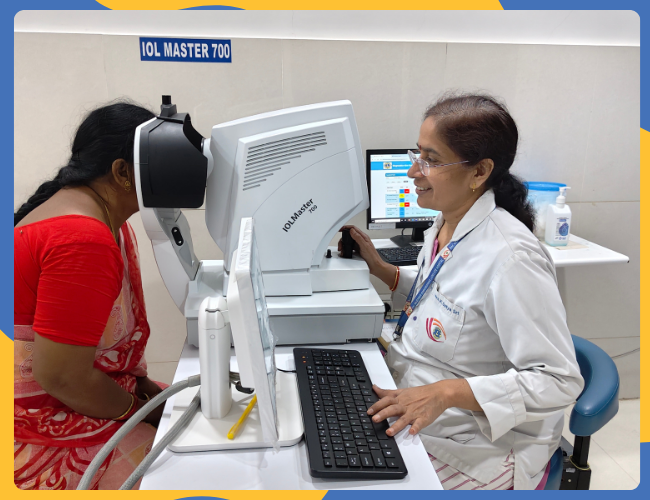
Your ophthalmologist will perform a comprehensive eye examination, including:
- Visual acuity test
- Slit lamp evaluation
- Fundus examination
- Intraocular pressure check
Based on the findings and your lifestyle, the doctor will recommend the most suitable treatment plan.